A crypto casino works much like any online casino — you register, fund an account, play games and withdraw. The difference is the money layer: instead of banks and card networks, value moves across public blockchains.
What a crypto casino is
A crypto casino is an online gambling operator that accepts cryptocurrency for deposits and pays out in cryptocurrency. Some accept only crypto; others accept crypto alongside traditional payment methods. Most offer the same categories of games you'd find elsewhere — slots, table games, live dealer tables — and many add crypto-native games such as dice or “crash” that were designed around on-chain verification.
Despite the name, very few crypto casinos run their games “on the blockchain”. The blockchain is usually used only for moving money in and out. Gameplay happens on the operator's servers, just like a conventional casino.
Accounts and custody
When you register, the casino creates an account with an internal balance. That balance is custodial: the operator controls the private keys to the coins you deposit. You're trusting the casino to keep the funds safe and to honour withdrawal requests — exactly as you'd trust a bank or an exchange.
If an operator becomes insolvent, freezes accounts or is hacked, players have historically had little recourse — especially where the licensing authority offers no dispute service. Keep only what you plan to play with in a casino account.
Some casinos display your balance in the coin you deposited; others convert it to a fiat-equivalent display or even to a stablecoin internally. Check which one applies, because it changes how price movements affect you.
How deposits are credited
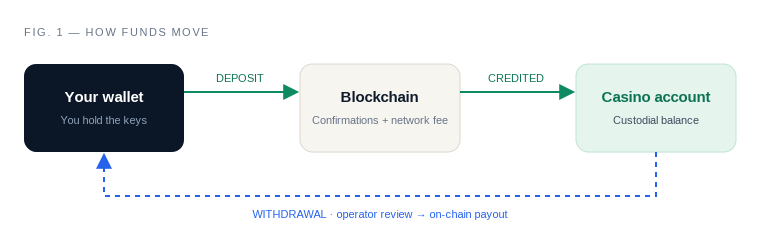
- The casino issues a deposit address. Most generate a unique address per user and per network, so incoming payments can be matched to your account automatically.
- You send coins from your wallet. You pay a network fee to the blockchain's validators or miners — not to the casino.
- The network confirms the transaction. Each casino sets how many confirmations it waits for before crediting. More confirmations mean more certainty the transaction won't be reversed by a chain reorganisation.
- Your balance is credited. At this point the coins sit in the casino's wallets, and you see a matching balance in your account.
The full step-by-step process, including networks and memos, is in our guide to depositing and withdrawing crypto.
How games decide results
Random number generators (RNG)
Traditional slots and table games use a random number generator — software that produces unpredictable outcomes. At reputable casinos, these games come from established studios whose RNGs are tested by independent laboratories, and the casino integrates them rather than building its own. You can't verify an individual spin yourself; you rely on the testing and the regulator.
Provably fair games
Many crypto casinos also offer “provably fair” games. They use a commit-reveal scheme so that you can check each result:
- Commit. Before you play, the casino shows you a cryptographic hash (for example SHA-256) of a secret server seed. The hash commits the casino to that seed without revealing it.
- Contribute. You supply or accept a client seed. Each bet also has a nonce — a counter that increases with every round.
- Combine. The result is derived from the server seed, client seed and nonce, typically using a function such as HMAC-SHA256.
- Reveal and verify. When you rotate seeds, the casino reveals the original server seed. You hash it to confirm it matches the commitment, then recompute your past results.
It proves that a result wasn't changed after you placed your bet. It doesn't prove that the game's payout table is generous, that the house edge is as advertised elsewhere, or that the operator will pay out.
The house edge
Every casino game is designed so that, over many rounds, the operator keeps a percentage of the money wagered. This is often expressed as return to player (RTP): a slot with 96% RTP is expected to return 96 units for every 100 wagered across a very large number of spins — meaning a 4% house edge. Individual sessions vary wildly; the long-run maths does not. Crypto changes how you pay, not these odds.
How withdrawals work
To cash out, you enter a wallet address and an amount. The request then goes through two stages:
- Operator review. The casino checks for bonus-term compliance, fraud signals and, often, identity verification. This is usually the slow part.
- On-chain settlement. Once approved, the casino broadcasts a transaction to your address. Depending on the network, it arrives in seconds to an hour or so.
Withdrawal limits, minimums and fees vary by operator and by coin. Always read them before depositing.
Who oversees crypto casinos
Crypto casinos are licensed — or not — by national or regional gambling regulators. Standards vary a great deal between authorities, and some operators run without any licence. Whether you are permitted to play also depends on the law where you are, not only where the casino is licensed. Our guide Are crypto casinos legal? unpacks this properly.
Crypto vs. traditional online casinos
| Aspect | Crypto casino | Traditional online casino |
|---|---|---|
| Payment rails | Public blockchains | Cards, bank transfers, e-wallets |
| Reversibility | Transactions can't be reversed | Chargebacks may be possible |
| Payout speed | Fast once approved | Often days for bank transfers |
| Value stability | Volatile unless using stablecoins | Stable in your currency |
| Game verification | RNG plus optional provably fair | Independently tested RNG |
| Regulation | Varies widely; often offshore | Often licensed in the player's market |
- The blockchain handles payments; games usually run on the operator's servers.
- Your casino balance is custodial — the operator holds the keys.
- Provably fair proves results weren't altered, not that you'll win.
- Licensing and your local law matter as much as the technology.